Google AI Mode searches are 3× longer. Learn how AI Mode ads work, what AI Max changes, and how businesses should prepare their Google Ads campaigns.
Google is changing how people search, and that is starting to change how advertising works.
On 28 October 2026, Google announced that it was expanding ads in AI Mode to ten additional countries, including India, Canada and Australia.
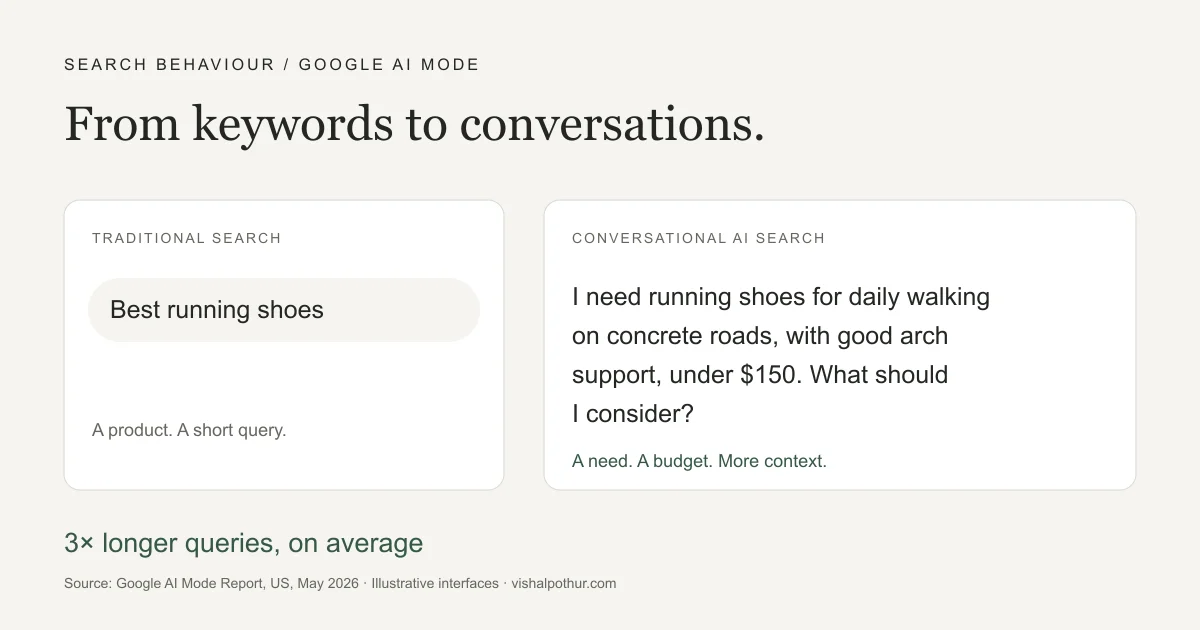
The announcement included an interesting finding: queries in Google AI Mode are three times longer on average than traditional searches, based on Google's May 2026 research in the United States.
But what does that mean if you're running Google Ads?
Does it change the way you target customers? Do you need to start using AI Max? Will your existing Search campaigns still work?
Let's look at what Google has announced, how AI Mode advertising works and what I would review before changing a campaign.
What are Google AI Mode ads?
Google AI Mode is an AI-powered Search experience where people can ask detailed questions, compare options and continue a conversation with follow-up queries.
Unlike a traditional search results page, AI Mode can generate a response using information from multiple sources and provide links for further exploration.
Google can also display relevant advertisements within or alongside these AI-powered responses.
For example, a person might ask:
"I'm looking for running shoes for daily walking on concrete roads. I need good arch support, and my budget is under $150. What should I consider?"
Google can help the person understand the available options and, where relevant, display sponsored products or businesses.
The advertising opportunity is not limited to someone typing a product name.
An ad may become relevant while the person is researching a problem or comparing possible solutions.
However, Google clearly labels these advertisements as Sponsored. Paid placement does not mean a business controls Google's organic AI-generated answer.
Why does Google say AI Mode searches are three times longer?
Google's reported three-times figure compares the average length of AI Mode queries with traditional searches in its US research.
This is about query length, not three times more searches, three times more conversions or three times more advertising revenue.
The difference becomes easier to understand with an example.
A traditional search might be:
"Best Shopify theme"
A conversational AI Mode query might be:
"I run a fashion store on Shopify with around 300 products. Most customers visit on mobile, and the current theme makes it difficult to find products by size and colour. What should I look for in a new theme?"
The second query provides much more context.
The person has described their business, current problem and requirements.
For an advertiser, that additional context may help Google's systems identify relevant products or services.
It can also reveal details that are not always obvious from a short keyword.
But longer doesn't necessarily mean higher buying intent.
Someone asking a detailed question may still be months away from making a purchase.
That is why advertisers should understand the context behind a search instead of assuming every AI Mode visitor is ready to buy.
How do ads appear in Google AI Mode?
Google describes two broad ways that advertisements can match searches in AI-powered experiences.
1. Direct query matching
This happens when the person already has a clear commercial need.
For example:
"Buy waterproof hiking shoes"
The search directly indicates interest in a product.
Google can identify relevant advertisements based on the query, similar to conventional search advertising.
2. Contextual matching
This is more interesting for advertisers.
Someone might ask:
"Why do my shoes get wet during long hikes, and how can I prevent it?"
The question does not specifically ask to buy shoes.
But a useful answer may discuss waterproof materials, footwear construction and outdoor equipment.
An advertisement for relevant waterproof footwear could become useful within that conversation.
Google's documentation explains that contextual matching can consider both the original question and the AI-generated response.
This creates opportunities to reach people earlier in their research process.
It also creates a measurement challenge: the commercial value of an exploratory search may be different from that of a direct purchase query.
Which Google Ads campaigns can appear in AI Mode?
According to Google's advertising documentation, several campaign and targeting approaches can participate in eligible AI-powered search placements.
| Campaign or targeting approach | AI Mode advertising relevance |
|---|---|
| AI Max for Search | Can support direct and contextual matching through search term matching |
| Broad match Search campaigns | Eligible for direct and contextual matching |
| Performance Max | Eligible for relevant AI-powered placements |
| Shopping campaigns | Eligible for relevant shopping placements |
| Exact and phrase match | Eligible for direct commercial query matching, but not broader contextual matching as described by Google |
Eligibility does not guarantee that an individual ad will appear.
Ad serving still depends on factors such as relevance, bidding, campaign eligibility and the availability of the placement.
Also, advertisers should distinguish AI Mode from AI Overviews. They are different Google Search experiences, even though both use AI.
Do you need AI Max to advertise in Google AI Mode?
No. AI Max is one available approach, not the only way to participate in eligible AI Mode placements.
AI Max is a set of AI-powered features for existing Search campaigns. It is not a separate campaign type.
Its features include search term matching, text customisation and final URL expansion.
These can help advertisers reach queries beyond their manually selected keywords, adapt advertising copy and direct visitors to relevant pages.
That may be useful when people describe their needs in ways that traditional keyword research does not fully anticipate.
But I would not enable every AI Max feature across an entire account simply because Google announced an AI Mode expansion.
Before testing AI Max, I would review:
- Whether the campaign already produces profitable conversions.
- Whether conversion tracking records genuine customer actions.
- Whether landing pages answer different customer needs.
- Whether the advertiser has suitable brand and location controls.
- Whether sufficient budget and conversion data are available for a useful test.
For an established account, a controlled experiment is generally more informative than changing every campaign simultaneously.
The bigger issue: Are your landing pages ready for conversational searches?
This is where I think businesses need to pay attention.
Let's say you run an online furniture brand.
Your Google Ads campaigns attract someone looking for an office chair.
Your landing page shows a product photograph, price and Add to Cart button.
That might work for someone who knows exactly which chair they want.
But another customer could be researching:
"Which office chair is suitable for someone who works from home for eight hours a day and needs adjustable lumbar support?"
That customer needs information about comfort, adjustability, materials, dimensions and practical use.
If your product page doesn't explain these things, your ad may attract a relevant visitor without helping them make a decision.
Better targeting alone doesn't solve that problem.
I would review product information, comparison content, FAQs, pricing clarity, shipping policies and customer support questions.
The same applies to service businesses.
A founder searching for help with inconsistent sales may need to understand how a consultant diagnoses the problem before being ready to book a meeting.
The landing page should answer the questions that matter to that buyer.
What happens to SEO when Google searches become more conversational?
AI Mode changes how people discover information, but it does not eliminate the importance of SEO.
Google's Search Central documentation confirms that AI Mode and AI Overviews continue to rely on fundamental search systems and that normal SEO best practices remain relevant.
A business should still ensure that its website can be crawled, indexed and understood.
It should also publish useful content based on real customer questions and reliable expertise.
That does not mean stuffing a page with hundreds of long-tail keywords.
For example, a Shopify development company could explain how different themes affect product discovery, mobile performance and maintenance.
A footwear brand could explain how its products differ in fit, materials and intended use.
The aim is to provide information that helps people make decisions.
There is no guarantee that a page will appear in an AI-generated response, just as there is no guarantee of ranking first in traditional search.
Google AI Mode ads are expanding internationally
On 28 October 2026, Google announced an expansion of AI Mode advertising into ten additional markets:
Australia, Canada, India, Kenya, Malaysia, New Zealand, Nigeria, Pakistan, the Philippines and Singapore.
Google also announced plans for additional markets, including the United Kingdom, during the fourth quarter of 2026.
At the same time, Google introduced multiturn ads in the United States, allowing relevant advertisements to appear during follow-up queries in AI Mode.
This matters to international advertisers.
But campaign availability, placement formats and supported features may not be identical in every country.
If you advertise in multiple markets, verify the options available in each one and evaluate local performance separately.
Do not assume that performance reported in the United States will apply to India, the UK or another market.
Five things I would review before increasing Google Ads budgets
If I were assessing an advertising account after these announcements, I would focus on the following areas.
1. Search intent
Review the search terms and customer questions that already bring business to your website.
Separate direct purchase searches from comparison, research and problem-solving queries.
2. Landing-page relevance
Check whether your pages answer the questions customers are likely asking.
A relevant ad is not enough if the landing page leaves important questions unanswered.
3. Conversion tracking
Verify purchase events, conversion values, lead quality and offline conversion imports where appropriate.
You need reliable data before giving an automated bidding system more responsibility.
4. Campaign experiments
Test suitable AI-powered matching features against a meaningful baseline.
Evaluate incremental conversion value and customer acquisition cost instead of focusing only on impressions or clicks.
5. Actual business profitability
Compare advertising costs with contribution margins, customer value and repeat purchase behaviour.
The objective is not to generate the most conversions at any cost.
It is to acquire customers in a way that makes commercial sense.
Frequently asked questions
Are Google AI Mode ads available in India?
Google announced the expansion of ads in AI Mode to India on 28 October 2026. Availability for individual advertisers and placements may vary.
Are Google AI Mode searches really three times longer?
Google reports that AI Mode queries are three times longer on average than traditional searches, based on its US research from May 2026. This is an average query-length comparison, not a claim about every search.
Do I need AI Max for Google AI Mode ads?
No. Google also identifies broad match Search, Shopping and Performance Max as eligible approaches for relevant AI-powered placements.
Will AI Mode replace traditional Google Search ads?
Google has not announced the replacement of traditional Search advertising. AI Mode introduces additional advertising opportunities alongside existing experiences.
Can SEO help my business appear in AI Mode?
Google says its standard SEO recommendations remain relevant for AI-powered search. Pages must be eligible for indexing and search snippets to appear as supporting links. Inclusion is not guaranteed.
Should I increase my advertising budget because of AI Mode?
Not automatically. Review campaign performance, conversion measurement, landing pages and profitability before increasing spend.
Final thoughts
Google's three-times-longer-searches finding is interesting, but I wouldn't build an advertising strategy around that number alone.
What matters is that customers are getting more comfortable explaining what they need.
That gives advertising systems more context. It also means businesses need to provide better answers.
I would focus on understanding search intent, improving landing pages, checking conversion tracking and testing new campaign features carefully.
Because reaching more potential customers is useful only when those customers are relevant to your business.
And that is still a business-growth decision, not just a Google Ads setting.
About Vishal Pothur
Vishal Pothur is a Business Growth Strategist and Founder of Calyx Core, with over 11 years of experience in digital marketing and e-commerce.
He advises businesses on customer acquisition, growth strategy, Shopify, conversion optimisation, SEO, AI search visibility and revenue performance.
Explore business growth consulting: https://vishalpothur.com/
Sources
- Google — Ads in AI Mode expand to 10 new countries, 28 October 2026
- Google Ads — Ads in AI-powered experiences
- Google Ads — About AI Max for Search campaigns
- Google Search Central — AI features and your website
- Google Search Central — Optimising for generative AI Search

Vishal Pothur
Business Growth Strategist | Founder, Calyx Core
11+ years of experience in digital marketing and e-commerce.